USMLE · 7 min read
USMLE®: a roadmap for medical students in Uzbekistan
USMLE preparation: Step 1 and Step 2 CK, ECFMG certification, OET and Pathways, fees and timelines. A step-by-step plan for medical students in Uzbekistan, based on usmle.org and ecfmg.org.
- Published
In this article
A third-year student scrolls past Telegram ads for "USMLE recalls" and "Step 1 in three months". The real questions are simpler: how many Steps, is my school eligible, what does it cost, when to start? This guide sets out USMLE® preparation in order, from the official sources usmle.org and ecfmg.org only, as of October 2026.
What the USMLE is: three Steps
The USMLE is a three-step, computer-based examination for US medical licensure, run by the Federation of State Medical Boards (FSMB) and the NBME [1] and taken at Prometric test centres [1][4]. Step 1 and Step 2 CK can be taken in any order; Step 3 is open only after you pass both [1].
| Step | What it assesses | Format | Result |
|---|---|---|---|
| Step 1 | Basic sciences applied to medicine | ~280 questions, 14 blocks of 30 minutes, ~8 hours | Pass/fail (since 26 January 2022) |
| Step 2 CK | Clinical knowledge for patient care under supervision | ~316 questions, 16 blocks of 30 minutes, ~9 hours | Three-digit score, pass 218 (since 1 July 2025) |
| Step 3 | Unsupervised practice, ambulatory care | Two days: multiple-choice questions and CCS case simulations | Three-digit score |
Sources: [1][4]. Since 7 May 2026, a 30-minute Step 2 CK block holds at most 20 questions [3]: about 90 seconds each. Examinees typically need about 60% of questions right to pass [1].
International graduates take Step 3 after ECFMG certification, only in the US and its territories [1], so this guide covers the first two Steps.
What the exam covers
The official content outlines organise topics by organ system [2][3]. In Step 1, pathology makes up 45–55% of questions, physiology 30–40% and pharmacology 10–20%, and most questions ask you to interpret graphs and tables or identify gross and microscopic specimens [2]. In Step 2 CK, medicine makes up 55–65%, paediatrics 17–27%, obstetrics and gynaecology 10–20%, psychiatry 10–15% and surgery 5–15% [3]. Items can count in more than one discipline, so the ranges total over 100% [2][3].
Two things surprise many students from Uzbekistan: the weight of communication and biostatistics (in Step 1, communication and interpersonal skills 6–9%, biostatistics and epidemiology 4–6% [2]) and the pace, about 90 seconds for a long English vignette, sometimes with an image or audio [1]. Use the outline to find gaps, not as a curriculum [2]; for working through a vignette, see clinical reasoning.
ECFMG certification: the route for international graduates
If you study or studied outside the US, you are an international medical graduate (IMG) and need ECFMG certification. The 2026 ECFMG Information Booklet lists the requirements [6]:
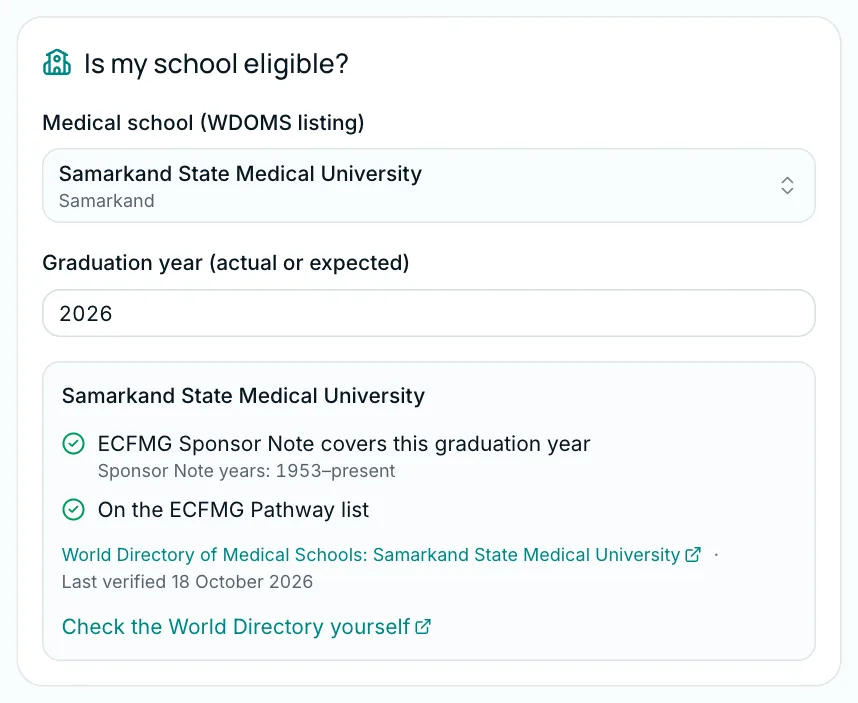
- School. Your school's page in the World Directory of Medical Schools (wdoms.org) must carry an ECFMG Sponsor Note covering your graduation year, or you cannot be certified [6].
- Application. You submit an Application for ECFMG Certification, and ECFMG verifies your diploma and final transcript with your school [6].
- Step 1 and Step 2 CK. You apply through the FSMB [1][6] and choose an eligibility period. Book a Prometric date as soon as your scheduling permit arrives: dates go first come, first served, availability is not guaranteed, and booking may not open more than six months ahead [1]. Students also need an accepted ECFMG application and the school's confirmation that they will finish the basic sciences before the eligibility period starts [6].
- Pathway and OET Medicine. A Pathway confirms clinical and communication skills. Every applicant, whatever their native language, takes OET Medicine and needs at least 350 in Listening, Reading and Speaking and 300 in Writing, in one sitting. For the 2027 Pathways the score must date from 1 January 2025 or later [7].
- The Match. For the 2027 Match, ECFMG advises taking OET by the last test date in December 2026, so your Pathway status reaches the NRMP, which runs the residency Match, in time [7].
ECFMG's list of schools eligible for the 2027 Pathways (updated 17 August 2026) has 8 schools in Uzbekistan, all under Pathway 3 [8]. For 2027, Pathway 3 also requires a school accredited by a WFME-recognised agency, graduation on or after 1 January 2024 and a school official's attestation of your clinical skills; applications close on 31 January 2027 [8]. If your school is not listed under its current name, or you graduated before 2024, ask ECFMG and check the other Pathways.
Timeline, attempts and costs
- Attempts. Four attempts at a Step without a pass, incomplete ones included, make you ineligible for every Step. You may take a Step at most three times in 12 months, and retake a passed Step only to meet a time limit set by a US licensing authority or another body the USMLE recognises [1].
- Seven-year rule. Step 1, Step 2 CK and an accepted Pathways application must fall within seven years of the first exam you pass, or your earliest pass stops counting for certification; ECFMG will not remind you [6]. Pass Step 1 early and the clock starts that day.
- Results. Usually within four weeks; allow at least eight [4].
- Fees (2026 and 2027). Step 1 and Step 2 CK cost US$695 each; outside the US and Canada a region fee of $210 (Step 1) or $235 (Step 2 CK) is added [5].
Worked example (fictional). Dilnoza, a fourth-year student in Samarkand, checks the Sponsor Note and her graduation year on wdoms.org, then finds Samarkand State Medical University under Pathway 3 on the ECFMG list [8], and will recheck both when she graduates. At 2026–2027 prices her exam fees are 695 + 210 = $905 for Step 1 and 695 + 235 = $930 for Step 2 CK, $1,835 in total [5]. ECFMG, OET and Pathway fees and travel come on top.
USMLE preparation year by year: a rough plan
One option for a six-year programme, not a fixed rule:
| Period | What to do |
|---|---|
| Years 1–2 | Medical English, basic sciences; check your school's Sponsor Note |
| Years 3–4 | Close gaps against the Content Outline, daily questions, Step 1 |
| Years 5–6 | Clinical rotations, Step 2 CK |
| Graduation year and after | OET Medicine, Pathway application, ERAS (the residency application service) and the NRMP Match |
OET scores count only for a limited time [7], so plan OET close to your Pathway application. usmle.org offers more than 100 free sample questions per Step, as a PDF and an interactive test [1]: use them early and again before the exam. The Bulletin's checklist also mentions buying an NBME Self-Assessment [1]. For daily review, see spaced repetition.
How to practise on MedIQ
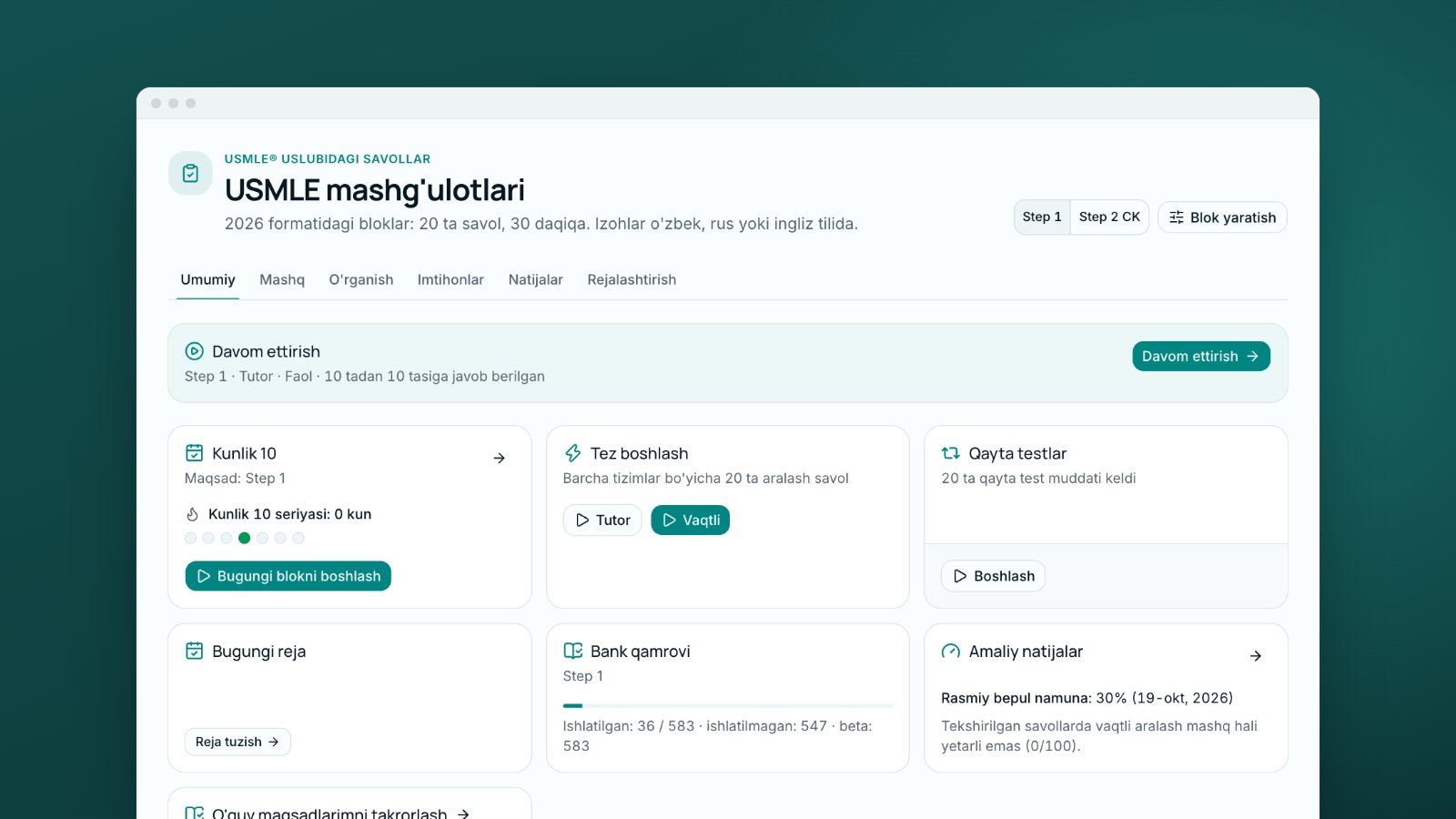
The MedIQ USMLE module has about 1,000 USMLE®-style questions: more than 500 for Step 1 and more than 550 for Step 2 CK (some count for both). They are English single-best-answer vignettes with US units and drug names. They were written with AI assistance and checked by MedIQ AI: automated rules, an independent check against an opened medical source and a translation check. All are Beta, not yet reviewed by a physician; if one looks wrong, press "Report a problem". The launch article covers the platform as a whole.
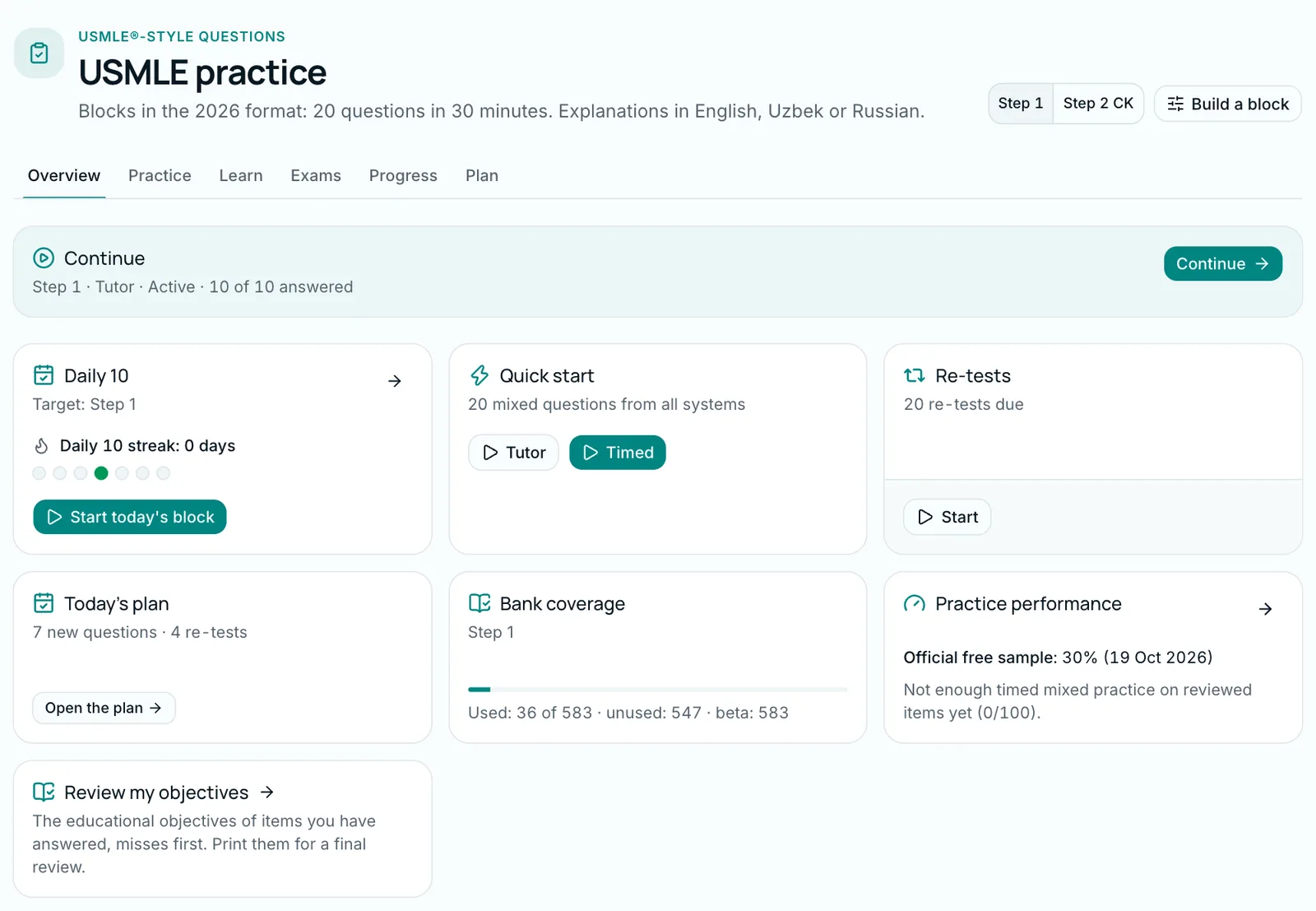
- Blocks. Tutor mode explains after each answer; Timed mode (PRO) gives 30 minutes for 20 questions and explains at the end.
- Three languages. Rationales and the "Educational objective" come in Uzbek, Russian or English, with the English key term bracketed; in Tutor mode, more than 700 terms translate with one tap.
- AI tutor (PRO) answers only from that question and its explanation, but it can be wrong.
- Daily work: Daily 10, themed sets, re-tests, Study plan (PRO), Analytics, Mistake log.
- Roadmap (Free): 9 steps, 60 sourced facts, a school checker for Uzbekistan, "Which Pathway?" and a cost calculator in so'm.
Limits: questions are text only, AI-assisted questions may be easier than real ones, and MedIQ predicts no score or pass chance, so do not compare your percentage with the 60% above. Free gives 10 questions per 24 hours (shared with Tests & review) in Tutor mode. The module is described on the MedIQ home page.
Sources
- 1.Federation of State Medical Boards (FSMB), NBME. 2027 USMLE Bulletin of Information. 2026. www.usmle.org/sites/default/files/2026-08/2027Bulletin.pdf
- 2.USMLE. Step 1 Exam Content (content outline and specifications). FSMB, NBME; accessed 23 October 2026. www.usmle.org/exam-resources/step-1-materials/step-1-content-outline-and-specifications
- 3.USMLE. Step 2 CK Exam Content (content outline and specifications). FSMB, NBME; accessed 23 October 2026. www.usmle.org/exam-resources/step-2-ck-materials/step-2-ck-content-outline-specifications
- 4.USMLE. Examination Results and Scoring. FSMB, NBME; accessed 23 October 2026. www.usmle.org/scores-transcripts/examination-results-and-scoring
- 5.USMLE. Step Exams: application fees for 2026 and 2027. FSMB, NBME; accessed 23 October 2026. www.usmle.org/step-exams
- 6.ECFMG, a division of Intealth. 2026 ECFMG Information Booklet: Requirements for ECFMG Certification; Eligibility for the USMLE; Time Limit for Completing Examination Requirements. Intealth; accessed 23 October 2026. www.ecfmg.org/2026ib/2026ib.pdf
- 7.ECFMG. 2027 Pathways: Assessment of Communication Skills, Including English Language Proficiency (OET Medicine). 2026. www.ecfmg.org/certification-pathways/oet.html
- 8.ECFMG. 2027 Pathways: Pathways 3, 4, and 5, with the linked list of Medical Schools Eligible for 2027 Pathways (last updated 17 August 2026). Accessed 23 October 2026. www.ecfmg.org/certification-pathways/pathways-3-5.html
Tags
- USMLE
- Step 1
- Step 2 CK
- ECFMG certification
- OET Medicine
- exam preparation
- US residency
About the author
MedIQ Editorial
Editorial team for medical education
MedIQ Editorial is the team of clinicians and medical-education specialists who prepare the platform's learning content. Articles are based on current clinical guidelines (WHO, FIGO, ACOG, RCOG, NICE, ESHRE) and peer-reviewed research; sources are listed at the end of every article.