Medical industry · 4 min read
MedIQ is officially live: a platform for medical education and virtual clinical practice
MedIQ is officially live. AI virtual patients, 3D anatomy, adaptive questions, OSCE stations and a USMLE module on one platform: what it offers medical students, residents and young doctors.
- Published

In this article
A fifth-year student knows the anatomy, the pharmacology and the diagnostic criteria, but has never once decided alone, in front of a real patient, which question to ask first, which test to order and which sign is a red flag. Medical schools in Uzbekistan offer plenty of theory and little practice that can be repeated under supervision. MedIQ was built to close that gap.
As of today, MedIQ (mediq.uz) is officially live. It is a learning and virtual clinical practice platform for medical students, residents and young doctors, available in Uzbek, Russian and English. Below is what the platform consists of, which parts are free and how to make use of it in the first week.
What the platform is and who it is for
MedIQ is designed to shorten the distance between theory and clinical practice. Every module connects to the next: a lesson leads to a 3D model, a question to a clinical case, and a case to the leaderboard and the student's public profile [1]. The platform is aimed at students of the 41 medical universities in Uzbekistan, with separate sections for residents, young doctors, clinics and training centres [1].
In the first phase one specialty is covered in full: gynaecology and aesthetic gynaecology. Lessons, cases and 3D models are ready for pelvic anatomy, endocrine gynaecology, infections, oncogynaecological screening and aesthetic gynaecology. Further specialties will be added in stages [1].
The core modules
| Module | What it does | Plan |
|---|---|---|
| AI virtual patient | A patient with a hidden scenario: you take the history, order tests, write the diagnosis and plan; the AI scores guideline adherence and missed red flags | PRO |
| 3D interactive atlas | Real anatomical models with layers and names in Latin, Uzbek, Russian and English | Skeleton free, the rest PRO |
| Learning path | Lessons linked to a 3D model, questions and a case | 7 fundamental tracks free |
| Adaptive practice | Questions that adjust to your level, spaced repetition, a 40-question exam simulation | 10 questions a day free |
| OSCE stations | An 8-minute voice or text station, examiner questions, an official checklist | PRO |
| AI mentor | Answers only from guideline passages, every statement referenced | PRO |
| USMLE® preparation | More than 1,000 clinical vignettes with explanations in three languages | PRO, with a free taster |
| MedIQ Arena | Weekly and monthly clinical-case olympiads, leaderboard, certificates | Free |
| Career centre | A verified profile, QR-checkable certificates, invitations from clinics | Free |
Alongside these, an audio glossary in four languages, a reference covering more than 250 drugs and a marketplace of courses by practising experts are now open [1].
Why a virtual patient: what the evidence says
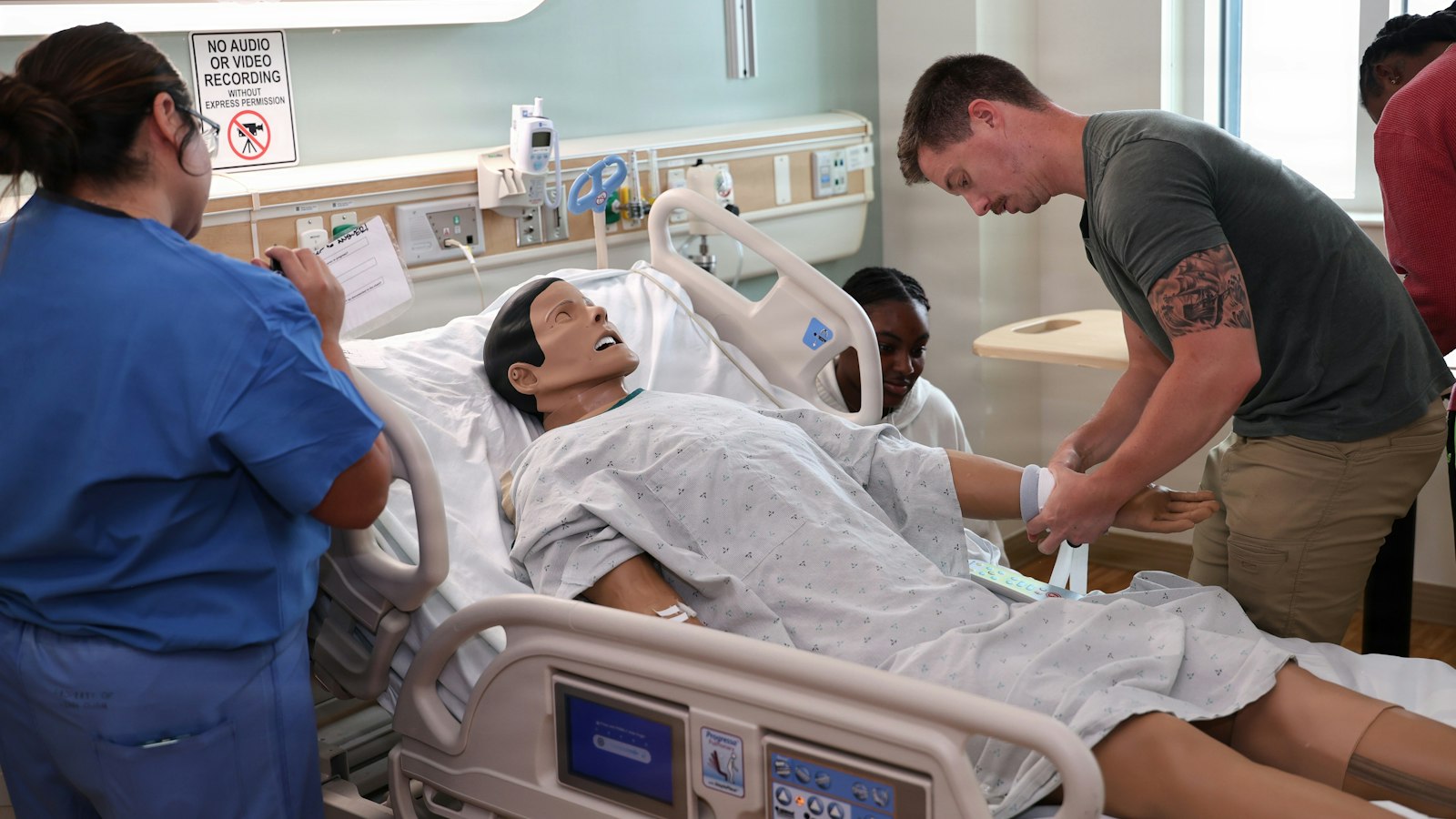
Simulation in medical education is not a new idea, and its effect is well studied. A meta-analysis of more than 600 studies found that technology-enhanced simulation produced clear gains in knowledge, skills and behaviours compared with no simulation [3]. The conditions under which simulation works are also known: immediate feedback, repeated practice, increasing difficulty and a safe environment [4].
The MedIQ virtual patient is built on those principles. Each case can be attempted as many times as you like, and feedback arrives at once with a score, strengths, errors and the source [1]. For consolidating knowledge the platform uses practice testing and spaced repetition, the two techniques rated highest in the largest review of learning methods [5].
Free and PRO
Registration is free. The Free plan permanently includes 7 fundamental learning tracks, the skeleton 3D atlas, 10 practice questions a day, the glossary, the drug reference, Arena and the leaderboard [2]. PRO opens every track and atlas, virtual patients, OSCE stations, the referenced AI mentor and unlimited questions. Once the account is verified, PRO is granted for 3 days at no cost, with no card required [2].
For clinics and experts
A student's results on the platform are counted automatically: solved cases, questions and olympiads feed a public profile. Clinics post internships and vacancies against those results and run sponsored olympiads [1]. Practising specialists publish video masterclasses on the marketplace, while payment and certificates are handled by the platform [1].
What to do in the first week
- Register for free and verify your account: PRO opens for 3 days.
- Choose your university: the learning tracks that match it are shown first.
- On day one, solve a single virtual patient case and study the errors in the feedback.
- Make 10 adaptive questions a day a habit.
- Enter the weekly Arena olympiad and see where you stand on the leaderboard.
Sources
- 1.MedIQ. Imkoniyatlar: platforma modullari. mediq.uz. 2026. mediq.uz/features
- 2.MedIQ. Tariflar: Bepul va PRO. mediq.uz. 2026. mediq.uz/pricing
- 3.Cook DA, Hatala R, Brydges R, et al. Technology-enhanced simulation for health professions education: a systematic review and meta-analysis. JAMA. 2011;306(9):978–988. doi.org/10.1001/jama.2011.1234
- 4.Issenberg SB, McGaghie WC, Petrusa ER, Lee Gordon D, Scalese RJ. Features and uses of high-fidelity medical simulations that lead to effective learning: a BEME systematic review. Med Teach. 2005;27(1):10–28. doi.org/10.1080/01421590500046924
- 5.Dunlosky J, Rawson KA, Marsh EJ, Nathan MJ, Willingham DT. Improving students' learning with effective learning techniques: promising directions from cognitive and educational psychology. Psychol Sci Public Interest. 2013;14(1):4–58. doi.org/10.1177/1529100612453266
Tags
- MedIQ
- virtual patient
- 3D anatomy
- OSCE
- medical education
- clinical practice
About the author
MedIQ Editorial
Editorial team for medical education
MedIQ Editorial is the team of clinicians and medical-education specialists who prepare the platform's learning content. Articles are based on current clinical guidelines (WHO, FIGO, ACOG, RCOG, NICE, ESHRE) and peer-reviewed research; sources are listed at the end of every article.