Medical industry · 7 min read
The MedIQ ECG course: from the basics to clinical ECG
Why ECG reading stays weak after graduation, what helps, and what the MedIQ ECG course contains: lessons, real ECGs, measuring tools, drills and the Level A exam.
- Published
In this article
A night shift. A nurse hands you a fresh ECG and asks, "Shall I call the cardiologist?" At that moment you need one thing: to read the tracing in your usual order so that you do not miss a danger sign. The MedIQ ECG course is built to train exactly that skill.
This post covers why ECG reading stays weak after graduation, what the research says helps, and what the course contains. New to MedIQ? Start with our launch post.
Why ECGs stay hard to read after graduation
Jablonover and colleagues listed 22 ECGs that a graduating student should recognise; two cardiologists verified each example [2]. A group of 231 graduating students and incoming residents identified 8.2 of the 22 on average; internal medicine residents finishing training identified 13.9. On the six life-threatening ECGs the scores were 3.4 and 4.6 out of 6, respectively. Scores were associated with self-rated confidence and with ECG exposure in the clinical years (years 3–4 of a US medical school) [2].
A 2020 systematic review and meta-analysis by Cook, Oh and Pusic pooled 78 studies with 10,056 participants [1]. Pooled accuracy without additional training was 42.0% in medical students, 55.8% in residents, 68.5% in practising physicians and 74.9% in cardiologists, and results varied widely between studies. Gaps remained at every training level, even after educational interventions [1].
What helps people learn
In the same meta-analysis, median accuracy was 54% before training and 67% after [1]: modestly higher, but still low. One course does not finish the job.
The strongest evidence favours a fixed routine. In a 2022 meta-analysis by Oh, Cook and colleagues (59 studies, 17,251 participants), teaching a more systematic approach (a schema or an algorithm) had the largest effect [7]. The 10-step routine below is one such approach.
How practice is organised may matter too. In Hatala and colleagues' experiment, students given the same instruction practised either one diagnosis at a time or with diagnoses mixed. On the final test the mixed group reached 46% accuracy, the blocked group 30% [3]. But this was a single two-hour session with 66 first-year students, and pooled studies of such contrastive practice showed no significant difference [7]. Mixing diagnoses is called interleaving; our post on spaced repetition covers it too.
In a meta-analysis of 13 studies, Viljoen and colleagues found computer-assisted instruction overall no better than face-to-face teaching, though blended learning (online material on top of classes) beat face-to-face teaching alone, especially with deliberate practice and feedback [4]. The larger 2022 meta-analysis found a small but significant advantage for computer-assisted instruction, which the authors linked in some studies to more practice [7]. So an online course adds practice and a fixed routine to the teaching in your department rather than replacing it.
What the ECG course contains
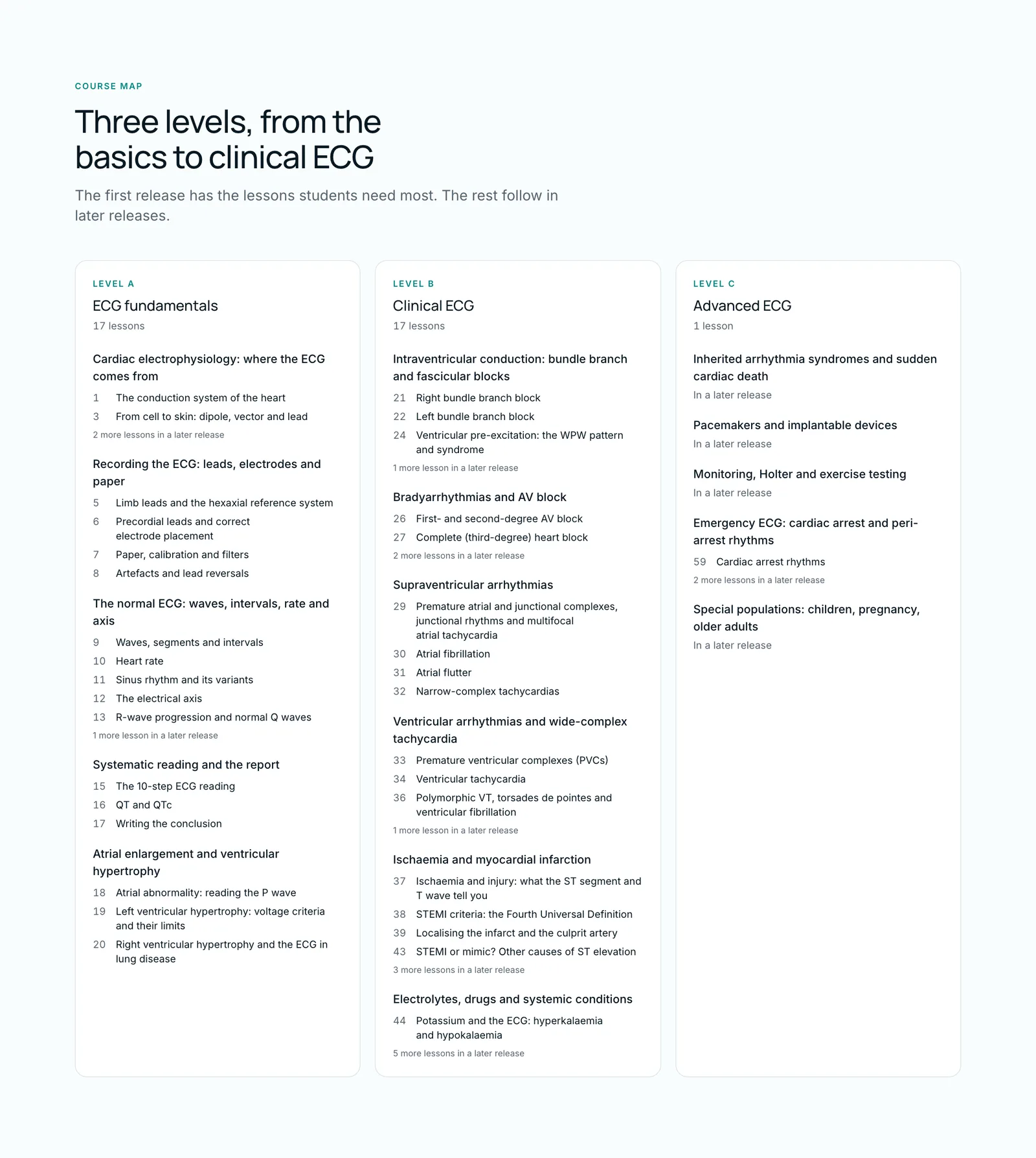
The course has three levels: "ECG fundamentals" (A), "Clinical ECG" (B) and "Advanced ECG" (C). The first release has 35 lessons: 17 at Level A, 17 at Level B and one at Level C ("Cardiac arrest rhythms"). Each lesson takes 15–25 minutes and ends with its sources; about 12 hours in all.
| Part | What it gives you |
|---|---|
| Lessons | Text, real ECG strips, interactive widgets, "Check yourself" questions, a lesson quiz |
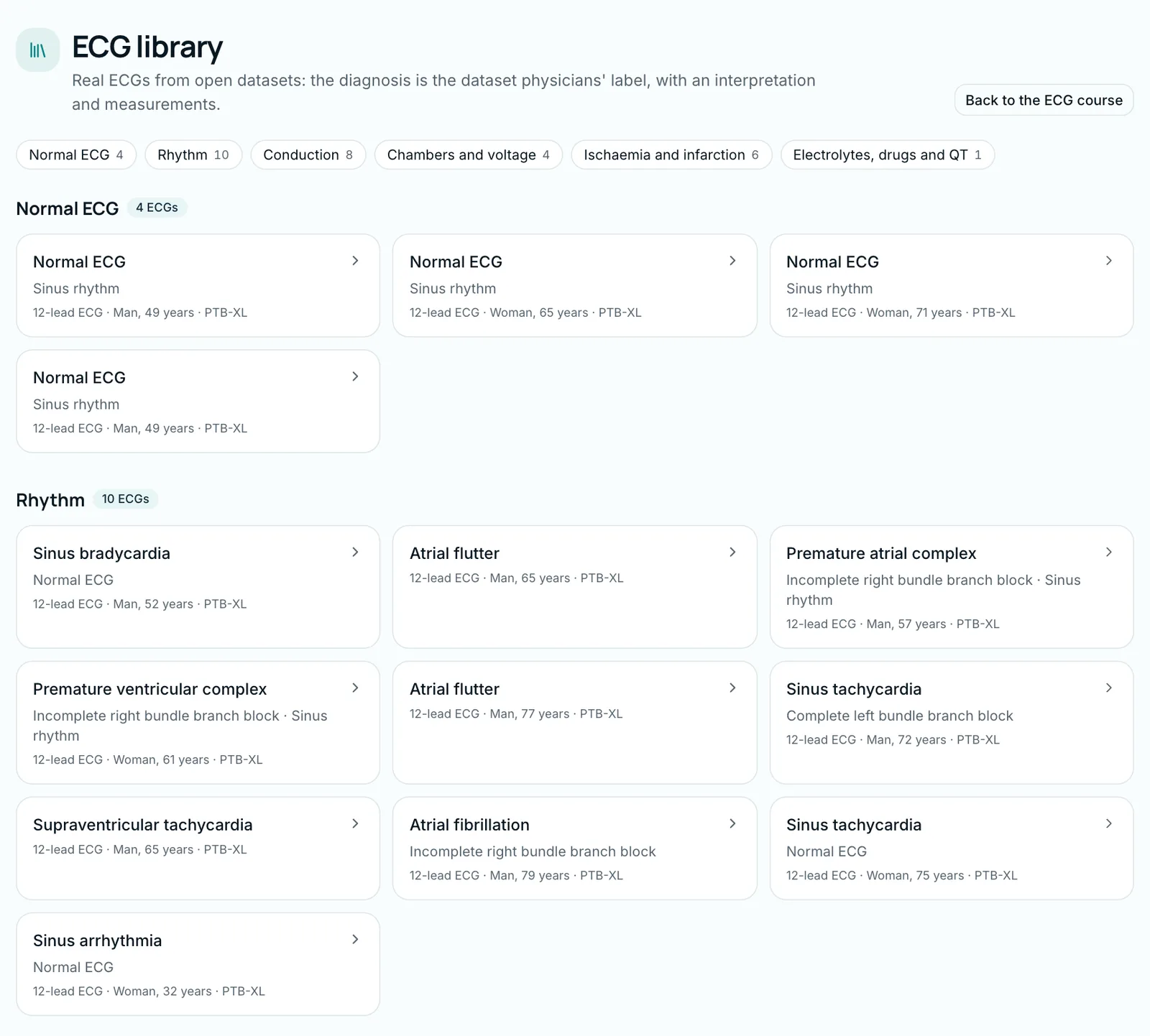
| ECG library | Over 30 real 12-lead ECGs with measurements and a step-by-step interpretation |
| ECG tools | Calipers, rate ruler, QTc and voltage calculators, axis wheel, rhythm generator, bedside monitor |
| 3D labs | 3D conduction lab and ECG machine trainer |
| Practice | Daily ECG, "Rhythm sprint" (90 seconds), "Full read" (five 12-lead ECGs), lesson quizzes |
| Level A exam | 30 questions, 45 minutes, at least 70% to pass; a pass earns the "ECG fundamentals" certificate |
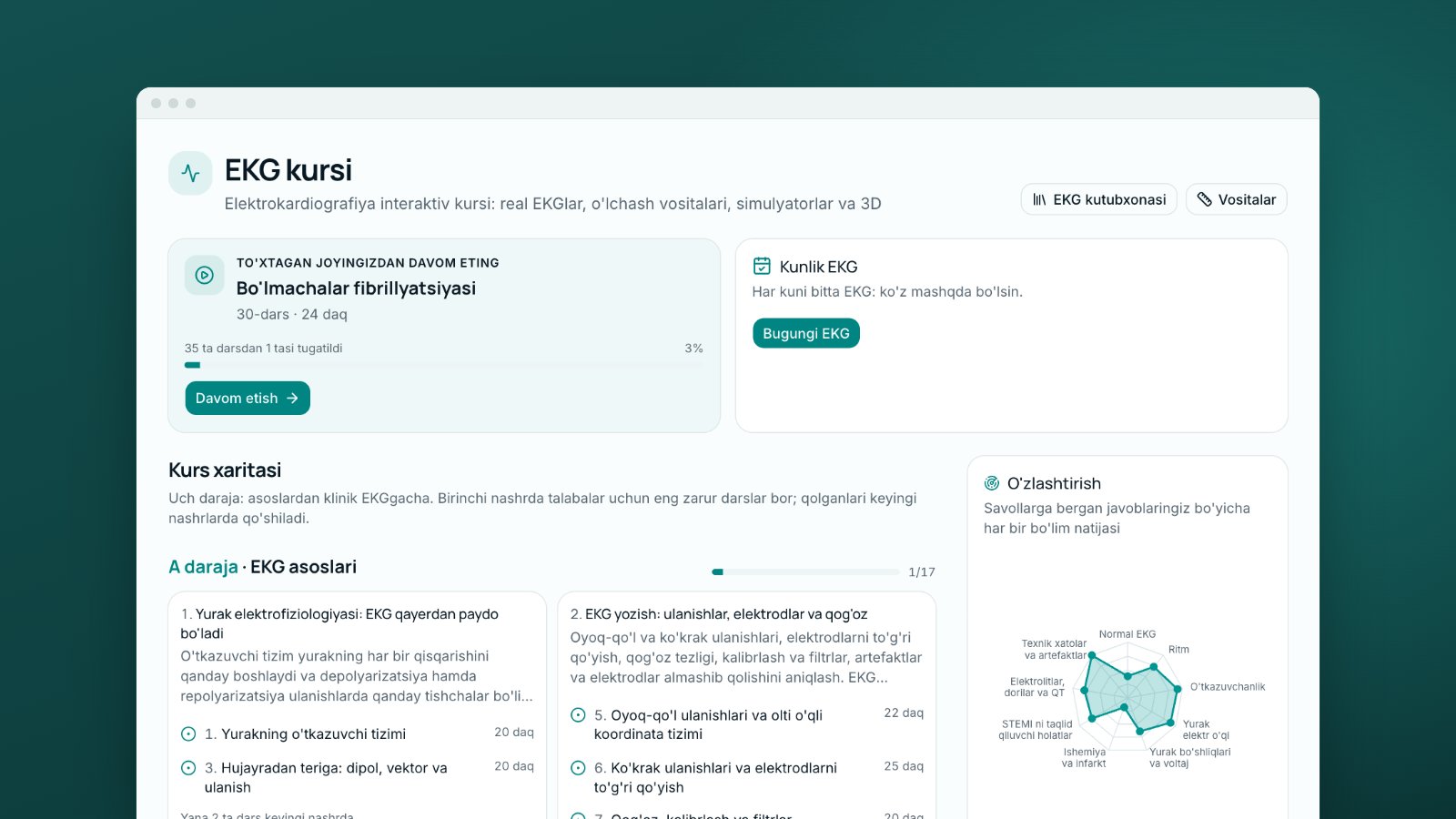
The course holds more than 190 real ECGs, over 450 questions and more than 50 model rhythms and patterns. A short overview is on the ECG course page.
How the course is built
Real ECGs from open datasets. All real recordings come from five open datasets on PhysioNet [6]. The largest, PTB-XL, was published in 2020 with 21,837 ten-second 12-lead ECGs from 18,885 patients, annotated by up to two cardiologists using 71 SCP-ECG statements [5]. The diagnosis the course shows is the dataset's own label; MedIQ AI does not re-diagnose it. STAFF III labels instead record which coronary artery was balloon-occluded during angioplasty. Every real strip carries its source and licence; in drills and the exam the dataset name appears only after you answer.
The "Model" badge. Synthetic strips always carry it: they are generated by a model, not recorded from a patient.
Beta and error reports. Lessons, library ECGs and the course pages carry the note "Beta · Checked by MedIQ AI, not yet by a physician". Every lesson, question and ECG was checked by two independent AI reviewers and an AI adjudicator. ECGs whose dataset label did not hold up on measurement were left out. Found a mistake? Press "Report an error": a confirmed error hides the item until it is fixed, and you are then notified.
Worked example: one ECG in 10 steps
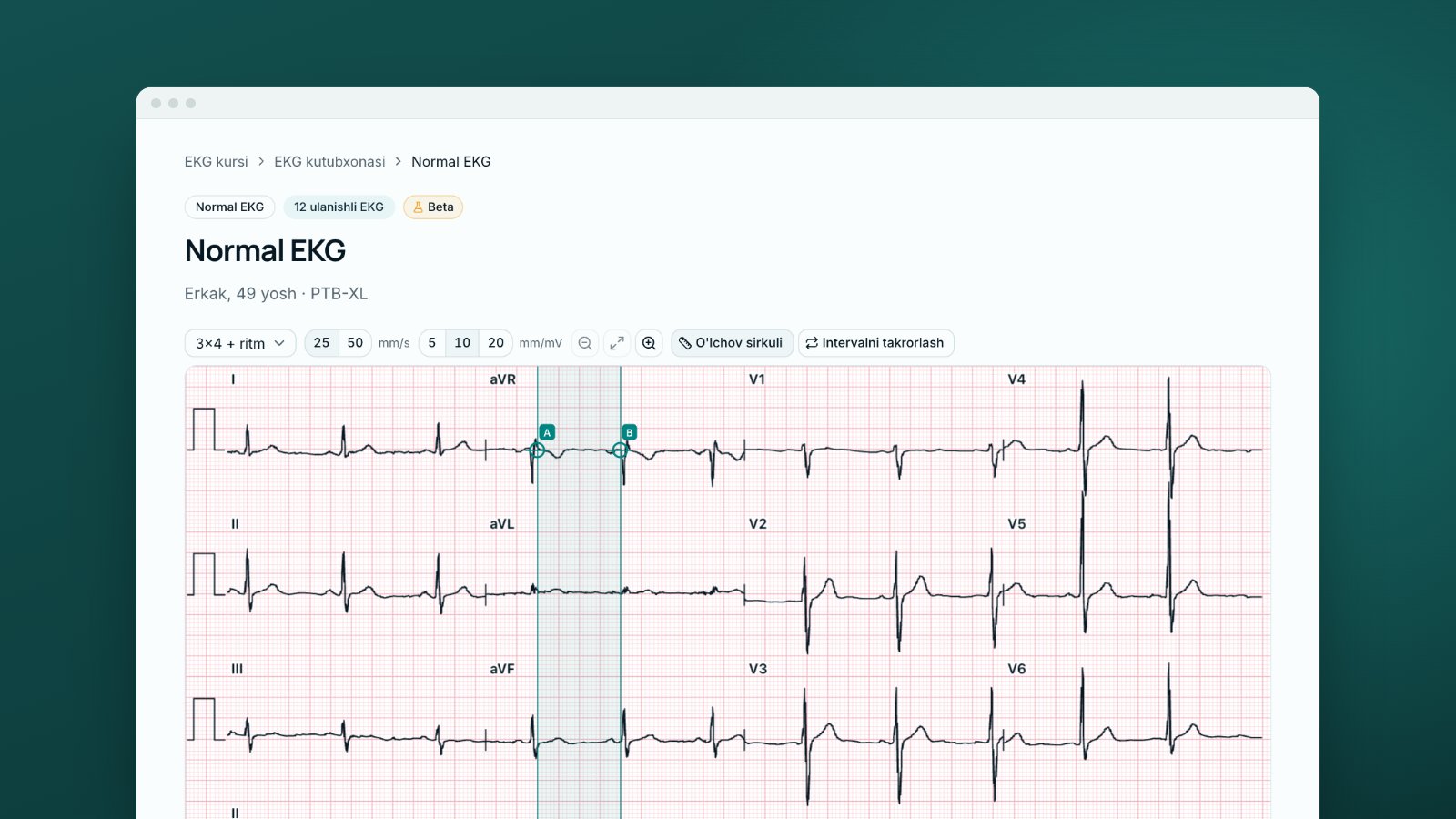
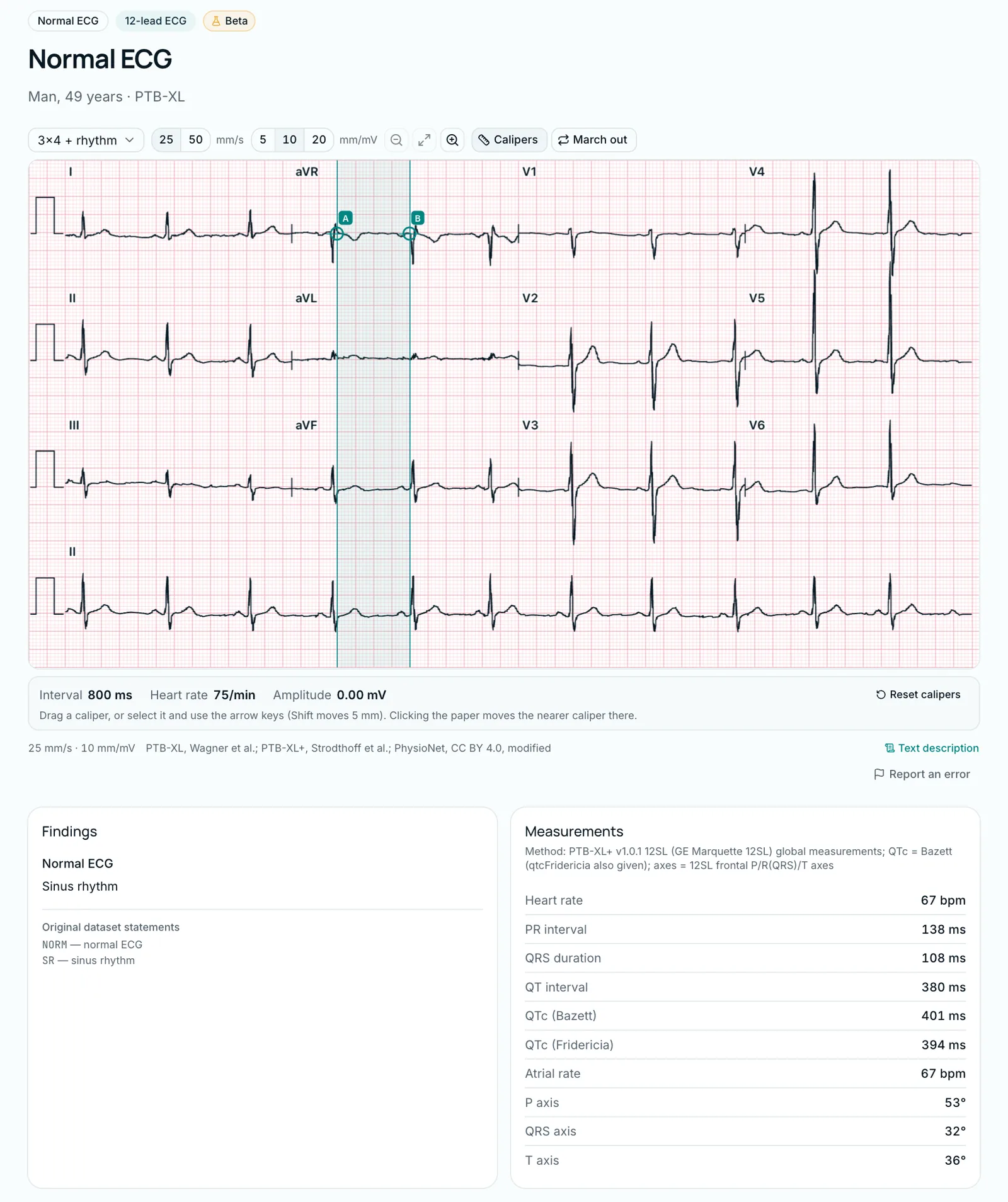
Lesson 15 ("The 10-step ECG reading") teaches one routine: context → quality → rate → rhythm → axis → intervals → P and QRS → ST → T/U → comparison and conclusion. The library reads one PTB-XL record, the "Normal ECG" of a 49-year-old man, in this order. It has no clinical context or earlier ECG, so the reading starts at the rate. Its numbers are automatic measurements by an algorithm, not a physician, from the companion PTB-XL+ dataset [8].
- Rate (step 3): 67/min. Check it: measure the RR interval with calipers. 60,000 ÷ 67 ≈ 896 ms; at 25 mm/s a small box is 40 ms, so the RR is about 22 small boxes.
- Rhythm (step 4): sinus — P upright in I and II, negative in aVR, one P before every QRS.
- Axis (step 5): +32°, normal.
- Intervals (step 6): PR 138 ms, QRS 108 ms, QT 380 ms, QTc (Bazett formula) 401 ms.
- P, QRS, ST and T (steps 7–9): normal P wave; no pathological Q waves, normal R-wave progression (transition around V3–V4), normal voltage; ST isoelectric; T upright in I, II and V2–V6, inverted in aVR.
- Conclusion (step 10): "Sinus rhythm, rate 67/min. Normal ECG." It matches the original dataset statement ("NORM — normal ECG").
As the library's interpretation stresses, an ECG can be called normal only after every step. In the "Full read" drill you do this yourself: enter the rate, rhythm, axis, intervals and findings, and a rule-based grader, not an AI, marks each field at once. Missing a critical finding, such as STEMI or complete heart block, caps the score at 40%.
Who it is for and where to start
Level A is for students in years 2–6, Level B for interns, residents, GPs and emergency staff, Level C for cardiology, emergency and intensive care residents. The first release holds the lessons students need most; only the Level A exam exists so far.
- Start Level A at lesson 1 and go in order. Short of time? Read lessons 7, 9 and 10 first: paper and calibration, waves and intervals, heart rate.
- Do the "Daily ECG" every day and the lesson quiz after each lesson.
- A few times a week, run "Rhythm sprint" and "Full read": diagnoses come mixed, as in Hatala's mixed group [3], and "Full read" adds Level B ECGs.
- Finish Level A, then take the exam. You see your score and results by topic, not the answer key.
A pass earns the "ECG fundamentals" certificate, which anyone can verify by its code. It is a MedIQ course certificate, not a licence or proof of clinical competence. The course is for learning: decisions about a real patient's ECG follow clinical protocols and the responsible physician.
Sources
- 1.Cook DA, Oh SY, Pusic MV. Accuracy of physicians' electrocardiogram interpretations: a systematic review and meta-analysis. JAMA Intern Med. 2020;180(11):1461–1471. doi.org/10.1001/jamainternmed.2020.3989
- 2.Jablonover RS, Lundberg E, Zhang Y, Stagnaro-Green A. Competency in electrocardiogram interpretation among graduating medical students. Teach Learn Med. 2014;26(3):279–284. doi.org/10.1080/10401334.2014.918882
- 3.Hatala RM, Brooks LR, Norman GR. Practice makes perfect: the critical role of mixed practice in the acquisition of ECG interpretation skills. Adv Health Sci Educ Theory Pract. 2003;8(1):17–26. doi.org/10.1023/A:1022687404380
- 4.Viljoen CA, Scott Millar R, Engel ME, Shelton M, Burch V. Is computer-assisted instruction more effective than other educational methods in achieving ECG competence amongst medical students and residents? A systematic review and meta-analysis. BMJ Open. 2019;9(11):e028800. doi.org/10.1136/bmjopen-2018-028800
- 5.Wagner P, Strodthoff N, Bousseljot RD, Kreiseler D, Lunze FI, Samek W, Schaeffter T. PTB-XL, a large publicly available electrocardiography dataset. Sci Data. 2020;7(1):154. doi.org/10.1038/s41597-020-0495-6
- 6.Goldberger AL, Amaral LAN, Glass L, Hausdorff JM, Ivanov PC, Mark RG, Mietus JE, Moody GB, Peng CK, Stanley HE. PhysioBank, PhysioToolkit, and PhysioNet: components of a new research resource for complex physiologic signals. Circulation. 2000;101(23):e215–e220. doi.org/10.1161/01.CIR.101.23.e215
- 7.Oh SY, Cook DA, Van Gerven PWM, Nicholson J, Fairbrother H, Smeenk FWJM, Pusic MV. Physician training for electrocardiogram interpretation: a systematic review and meta-analysis. Acad Med. 2022;97(4):593–602. doi.org/10.1097/ACM.0000000000004607
- 8.Strodthoff N, Mehari T, Nagel C, Aston PJ, Sundar A, Graff C, Kanters JK, Haverkamp W, Dössel O, Loewe A, Bär M, Schaeffter T. PTB-XL+, a comprehensive electrocardiographic feature dataset. Sci Data. 2023;10(1):279. doi.org/10.1038/s41597-023-02153-8
Tags
- ECG course
- ECG interpretation
- electrocardiography
- ECG training
- medical education
- MedIQ
About the author
MedIQ Editorial
Editorial team for medical education
MedIQ Editorial is the team of clinicians and medical-education specialists who prepare the platform's learning content. Articles are based on current clinical guidelines (WHO, FIGO, ACOG, RCOG, NICE, ESHRE) and peer-reviewed research; sources are listed at the end of every article.