Study and exams · 7 min read
Why question practice beats rereading
Rereading feels productive, but medical practice questions work better. The evidence from medical education, how to get more from each question, and how an adaptive test finds your weak topics.
- Published
In this article
The night before the exam, you are reading the gynaecology chapter for the third time, and every page looks familiar. Next morning the question looks familiar too, but the answer will not come. Many students see medical practice questions only as a check on what they know. In fact, answering questions teaches, and it teaches more durably than rereading.
This article explains why rereading misleads and what medical-education research shows. It then covers how to get more from each question, how an adaptive test finds weak topics, and a routine built on 10 questions a day.
Why rereading feels good but does little
A second reading flows more easily, and the brain mistakes that ease for knowledge. When Karpicke, Butler and Roediger surveyed 177 students, most reread their notes or textbook again and again, and few tested themselves. The authors trace this to illusions of competence: a false sense of knowing that arises while studying [1].
In a classic experiment, students read a passage and then either reread it or took a test: they wrote down everything they could recall. Rereading won on a test five minutes later. After two days and after a week, the students who had taken the test remembered substantially more [2]. This is the testing effect: a test does not only measure memory, it also improves later retention [2][4]. Learning by pulling answers out of memory is called retrieval practice [1].
That is why cramming feels effective: rereading wins only on a test straight after reading, and two days later the students who took tests are ahead. In a second experiment, students who read the passage four times expected to remember it best a week later; the result was the opposite [2].
A large review of learning techniques rated rereading and highlighting low utility, and practice testing high, together with distributed practice. Its advice is direct: use practice testing instead of rereading [3]. You still read to understand a topic the first time; it is the second and third readings that questions should replace.
The forgetting curve and spaced repetition have their own article; here the focus is the question itself.
What the evidence from medical education shows
The testing effect is not only a laboratory finding. A 2008 review by Larsen and colleagues drew three lessons for medical education: test often and spaced out over time; questions that demand recall beat questions that only demand recognition; and feedback is crucial to learning from tests [4].
The same group then ran a trial with paediatric and emergency medicine residents [5]. After a teaching session on status epilepticus and myasthenia gravis, each resident took short-answer tests with feedback on one topic and studied a review sheet with the same content on the other: straight away and twice more, about two weeks apart. On a final test about six months later, the mean score was 39% for the tested topic and 26% for the studied one.
A systematic review of health professions education (BEME Guide No. 48) included 19 controlled studies that used short-answer and multiple-choice questions, simulation and standardised patients [6].
| Outcome measured | Outcomes favouring testing |
|---|---|
| Immediate learning | 5 of 6 |
| Long-term retention | 21 of 23 |
| Transfer to new situations | 7 of 7 |
Its conclusion: the benefit reaches beyond exam knowledge to clinical application [6].
How to get more out of medical practice questions
Multiple-choice questions carry one risk: the wrong options (distractors) can stick too. In Butler and Roediger's experiment, immediate or delayed feedback raised correct answers on a later test and reduced wrong-option intrusions [7]. So work in this order:
- Answer without the options first. Cover the options, read the stem and answer in your own words. Recognition becomes recall [4].
- Then choose an option. Commit even when unsure; the explanation shows where your guess went wrong.
- Always read the explanation, even when you were right. A lucky guess is not yet knowledge [7].
- Write one line for each wrong option: when would it be the right answer?
- Come back to your mistakes later. Repeated, spaced testing works better than a one-off test [4].
- Mix topics. The review rated interleaved practice moderate utility [3]; in the clinic, patients do not say which chapter they belong to.
Many questions open with a clinical vignette, a short patient description. Our article on clinical reasoning shows how to move from its findings to a hypothesis.
How an adaptive test works: the Elo rating
One fixed set of questions bores a strong student and overwhelms a beginner. One way adaptive systems solve this is the Elo rating from chess: each answer is a match between student and question, and the result updates the estimates of the student's skill and the question's difficulty. Pelánek calls the method simple, robust and effective [8].
MedIQ's adaptive session is a rule-based model of this kind, not artificial intelligence:
- you have a separate rating for each topic, and a new topic starts at 1000;
- a question's rating is fixed by its difficulty, from 900 for "Easy" to 1300 for "Expert"; only your topic rating moves after each answer;
- the engine picks the question you have about a 65% chance of answering correctly: hard enough to learn from, easy enough to keep you going;
- a session draws mostly on weak and little-practised topics, with about 15% of questions from random topics.
The 65% is a choice made by the MedIQ team, not a scientific standard. The geography practice system Pelánek describes, for example, uses an adjustable target success rate, with 75% given as an example [8].
A worked example: your first question in a new topic
You have just started the Contraception topic: rating 1000, mastery 50%. The level closest to 65% is "Easy", at about 64%, so your first question is usually an easy one.
- Correct: the rating rises by about 17 points, and mastery goes from 50% to 53%.
- Wrong: it drops by about 31 points, and mastery falls to 45%.
Missing an easy question costs more than missing a hard one, and a correct answer to a "Hard" question at 1000 earns about 31 points. After your first 10 answers in a topic the steps get smaller and the rating settles. At 80% mastery the topic is marked "Mastered".
Ten questions a day: a simple routine
The Free plan gives 10 questions a day, shared by adaptive sessions, topic drills and review. That is one short session, but done daily it adds up:
- Morning: one adaptive session. Read the explanation after every answer.
- End of the session: check the "By topic" block and note the topic whose rating fell.
- During the day: write one line for each question you missed: what did I confuse?
- Evening: instead of rereading the chapter, close your notebook and recall today's mistakes.
- Next day: clear the cards due for review first, then spend the rest of your 10 questions on that topic in a "Topic drill".
Lessons also end with a "Check yourself" quiz (5 questions) that does not count towards the daily 10.
How to practise this on MedIQ
The "Tests & review" module has more than 1,300 practice questions across 18 tracks and over 130 topics. Every question comes with an explanation, and most list their sources. The features page has an overview.
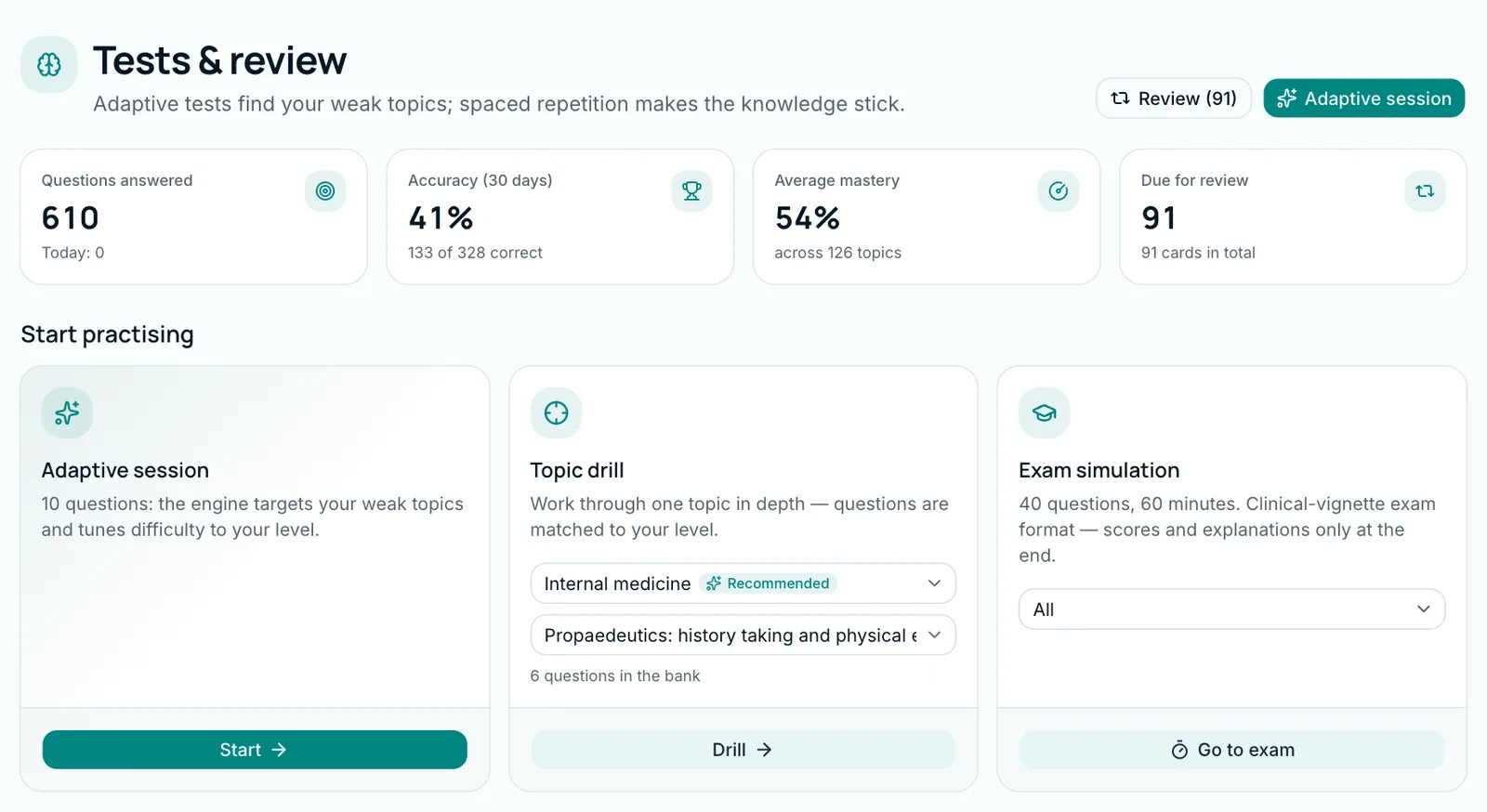
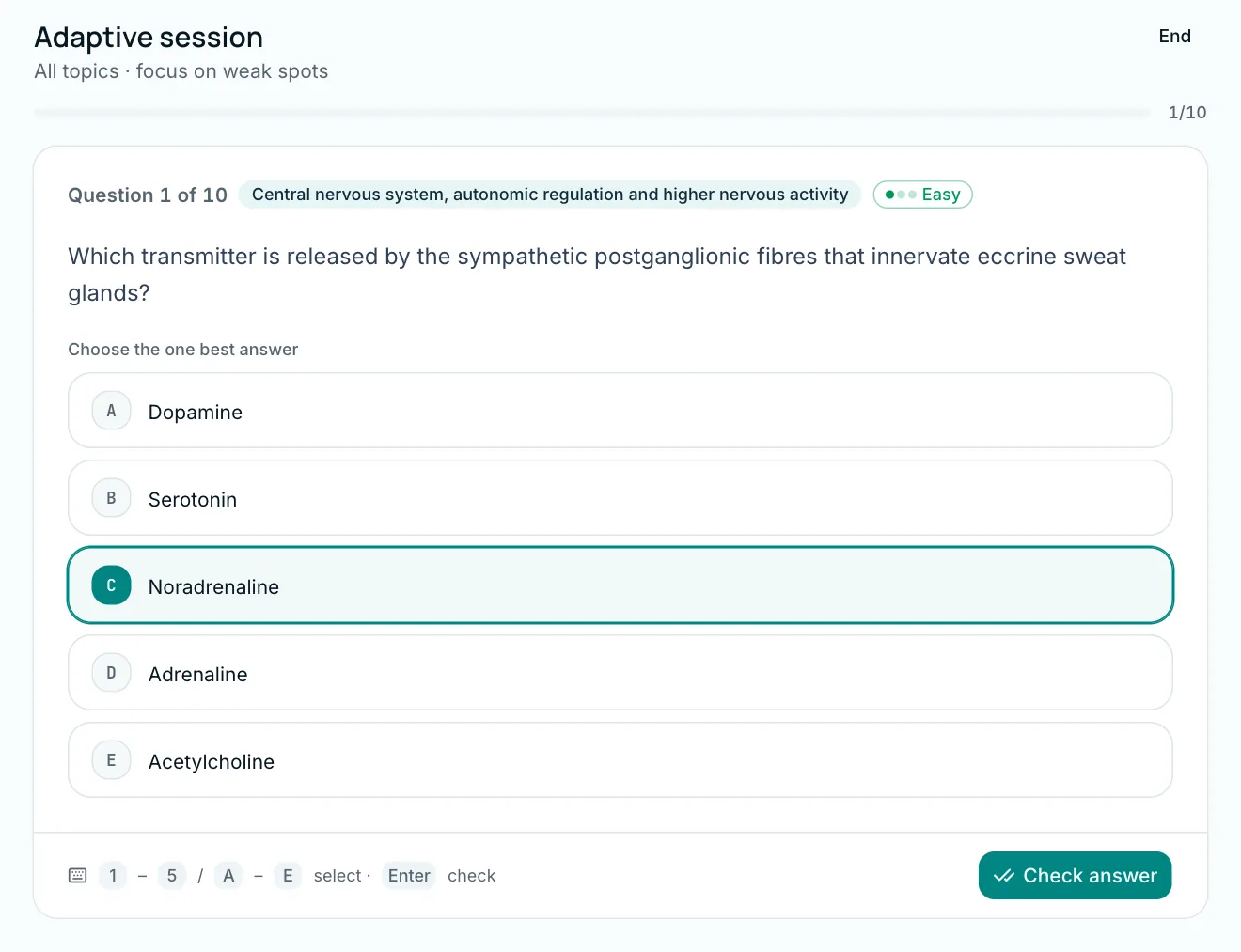
Questions come one at a time, with topic and difficulty badges. After you press "Check answer" you see the verdict and the "Explanation", the "References" for most questions, a "Read more" link when a lesson covers the point, and the change in your rating and topic mastery. A wrong answer goes to your review deck automatically.
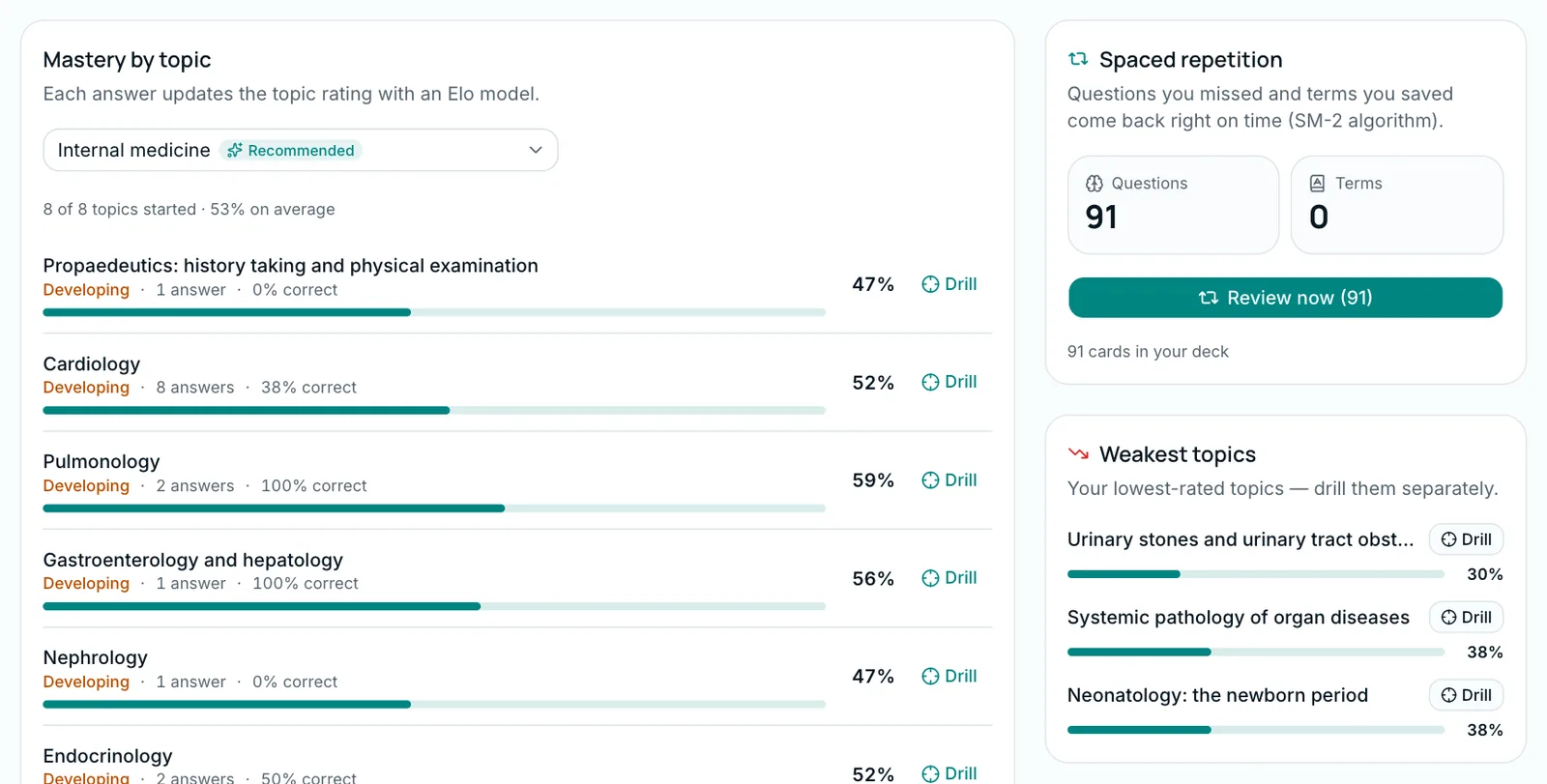
PRO opens the "Mastery by topic" map and the "Weakest topics" list. On Free the engine still targets weak topics and tunes difficulty; only these views are PRO.
Sources
- 1.Karpicke JD, Butler AC, Roediger HL. Metacognitive strategies in student learning: do students practise retrieval when they study on their own? Memory. 2009;17(4):471–479. doi.org/10.1080/09658210802647009
- 2.Roediger HL, Karpicke JD. Test-enhanced learning: taking memory tests improves long-term retention. Psychol Sci. 2006;17(3):249–255. doi.org/10.1111/j.1467-9280.2006.01693.x
- 3.Dunlosky J, Rawson KA, Marsh EJ, Nathan MJ, Willingham DT. Improving students' learning with effective learning techniques: promising directions from cognitive and educational psychology. Psychol Sci Public Interest. 2013;14(1):4–58. doi.org/10.1177/1529100612453266
- 4.Larsen DP, Butler AC, Roediger HL. Test-enhanced learning in medical education. Med Educ. 2008;42(10):959–966. doi.org/10.1111/j.1365-2923.2008.03124.x
- 5.Larsen DP, Butler AC, Roediger HL. Repeated testing improves long-term retention relative to repeated study: a randomised controlled trial. Med Educ. 2009;43(12):1174–1181. doi.org/10.1111/j.1365-2923.2009.03518.x
- 6.Green ML, Moeller JJ, Spak JM. Test-enhanced learning in health professions education: a systematic review: BEME Guide No. 48. Med Teach. 2018;40(4):337–350. doi.org/10.1080/0142159X.2018.1430354
- 7.Butler AC, Roediger HL. Feedback enhances the positive effects and reduces the negative effects of multiple-choice testing. Mem Cognit. 2008;36(3):604–616. doi.org/10.3758/MC.36.3.604
- 8.Pelánek R. Applications of the Elo rating system in adaptive educational systems. Comput Educ. 2016;98:169–179. doi.org/10.1016/j.compedu.2016.03.017
Tags
- testing effect
- medical practice questions
- study techniques
- adaptive testing
- retrieval practice
- exam preparation
About the author
MedIQ Editorial
Editorial team for medical education
MedIQ Editorial is the team of clinicians and medical-education specialists who prepare the platform's learning content. Articles are based on current clinical guidelines (WHO, FIGO, ACOG, RCOG, NICE, ESHRE) and peer-reviewed research; sources are listed at the end of every article.