Clinical practice · 8 min read
History taking: most diagnoses are found in the conversation
In classic studies of medical outpatients, the diagnosis was clear after the history in more than three quarters of patients. History taking: structure, how to ask, common mistakes and practice with a virtual patient.
- Published
In this article
A familiar scene on a clinical rotation: within five minutes of meeting a patient, a student orders a full blood count, an ultrasound scan and a hormone panel. The results arrive and the diagnosis is still unclear. Then the tutor asks two or three precise questions, and it all falls into place.
It is no accident: history taking is still the main diagnostic tool [1][2]. Below: the structure of a history, how to ask, common mistakes and how to practise with a virtual patient.
Why the history still comes first
In Hampton and colleagues' study, physicians recorded a diagnosis for each new patient after the referral letter, the history and the examination, then compared it with the diagnosis accepted two months later. In 66 of 80 patients, the diagnosis made after the letter and history matched the final one; the examination helped in only 7, and laboratory tests in another 7 [1].
Peterson and colleagues tested this prospectively in 1992 in 80 medical outpatients: the history led to the final diagnosis in 61 (76%), the examination in 10 (12%) and laboratory tests in 9 (11%) [2].
Examination and tests rule out some diagnoses and add confidence [2], but they test a hypothesis born in the conversation. Both studies were small and set in medical outpatient clinics, so the percentages will not hold on every ward. More on hypotheses in our post on clinical reasoning.
The structure of history taking: what to ask
The Calgary-Cambridge guide joins traditional history content with the communication process. The content covers the illness (sequence of events, symptom analysis, relevant systems review), the patient's perspective and background information (broadly, the anamnesis vitae of Russian-language textbooks) [3]:
| Section | What you ask |
|---|---|
| Presenting complaint | What brought the patient in, in their own words |
| History of presenting complaint | Onset, course, analysis of each symptom |
| Past medical and surgical history | Chronic conditions, admissions, operations |
| Medications and allergies | Prescribed, over-the-counter and herbal; for allergies, the reaction |
| Family history | Illness in close relatives |
| Epidemiological history | Contact with infection, travel, vaccinations |
| Social history | Work, smoking, alcohol, diet, home |
| Systems review | Brief system-by-system questions about what the patient has not mentioned |
In women, add the menstrual and obstetric history; ask both women and men about sexual history and contraception. Before these questions, explain why you ask and how confidentiality is kept.
How to analyse a symptom
For pain, use SOCRATES: Site, Onset, Character, Radiation, Associations, Time course, Exacerbating and relieving factors, Severity (for example, 0 to 10). Other symptoms follow the same logic: for bleeding, ask about amount, duration and pattern.
The patient's perspective is content too: what they think the cause is, what worries them, what they expect, and how the illness affects their life and mood [3]. The first three are known as ICE: ideas, concerns, expectations. Without knowing what the patient fears, your explanation may miss their real question.
How to ask: from open to closed questions
Calgary-Cambridge describes an "open-to-closed cone": the patient tells the story, then the clinician narrows the questions [3]:
- Greet the patient, introduce yourself and explain the purpose.
- Ask one open question ("What has been bothering you?") and listen without interrupting.
- Ask "Anything else?" There may be several problems.
- Only then move to closed questions: symptom analysis, red flags, the remaining sections.
- Summarise now and then, in plain words: "So, for two weeks now...?"
In 112 recorded encounters, clinicians elicited the patient's agenda in only 40 (36%), and in 27 of those (67%) they interrupted after a median of 11 seconds. Patients left uninterrupted needed a median of 6 seconds to state their concern [4].
Common mistakes in history taking
- Interrupting. The patient is cut off before finishing their concerns, and the visit may miss what matters most to them [4].
- Missing key information. Of 190 diagnostic errors in primary care, 78.9% involved the patient–clinician encounter, and errors related to the medical history (gathering or interpreting it) were found in 56.3% [5].
- Taking incomplete medication histories. In a systematic review of 22 studies, physicians' prescription medication histories at hospital admission had errors in up to 67% of cases, and 10–61% of patients had at least one pre-admission drug left out [6]. Ask separately about over-the-counter and herbal remedies and contraceptives.
Worked example: a woman with heavy periods
The case is invented. A 34-year-old woman says, "My periods are very heavy." NICE NG88 (2018, last updated July 2026) recommends that a heavy menstrual bleeding (HMB) history covers the nature of the bleeding; symptoms suggesting a uterine cavity or histological abnormality, adenomyosis or fibroids; the impact on quality of life; and factors that affect treatment options [7].
| Question (section) | Answer | What it changes |
|---|---|---|
| How many days, clots, since when? (history of presenting complaint) | 8 days, with clots, since her first period | HMB since menarche shapes the next questions |
| Bleeding between periods, pelvic pain, pressure? (systems review) | No | Without them, NG88 advises considering drug treatment without examination, unless a levonorgestrel-releasing intrauterine system (LNG-IUS) is chosen [7] |
| Any bleeding disorder in the family? (family history) | Her sister has one | HMB since menarche plus a personal or family history suggesting a coagulation disorder: consider testing (for example, for von Willebrand disease) [7] |
| How does it affect your life? (patient's perspective) | She misses two work days a month | Treatment aims to improve quality of life rather than focus on blood loss [7] |
| Planning a pregnancy? (reproductive plans) | Yes | Treatment options depend on it [7] |
History also shapes the tests: NG88 advises against female hormone testing, and against thyroid tests unless there are signs and symptoms of thyroid disease; a full blood count is recommended for every woman with HMB [7].
One-line summary: "34-year-old woman, heavy periods since menarche, no intermenstrual bleeding, pelvic pain or pressure symptoms, sister with a bleeding disorder; misses work, planning a pregnancy." This is a teaching example; decisions about a real patient follow local protocols and the responsible doctor.
How to practise history taking with a virtual patient
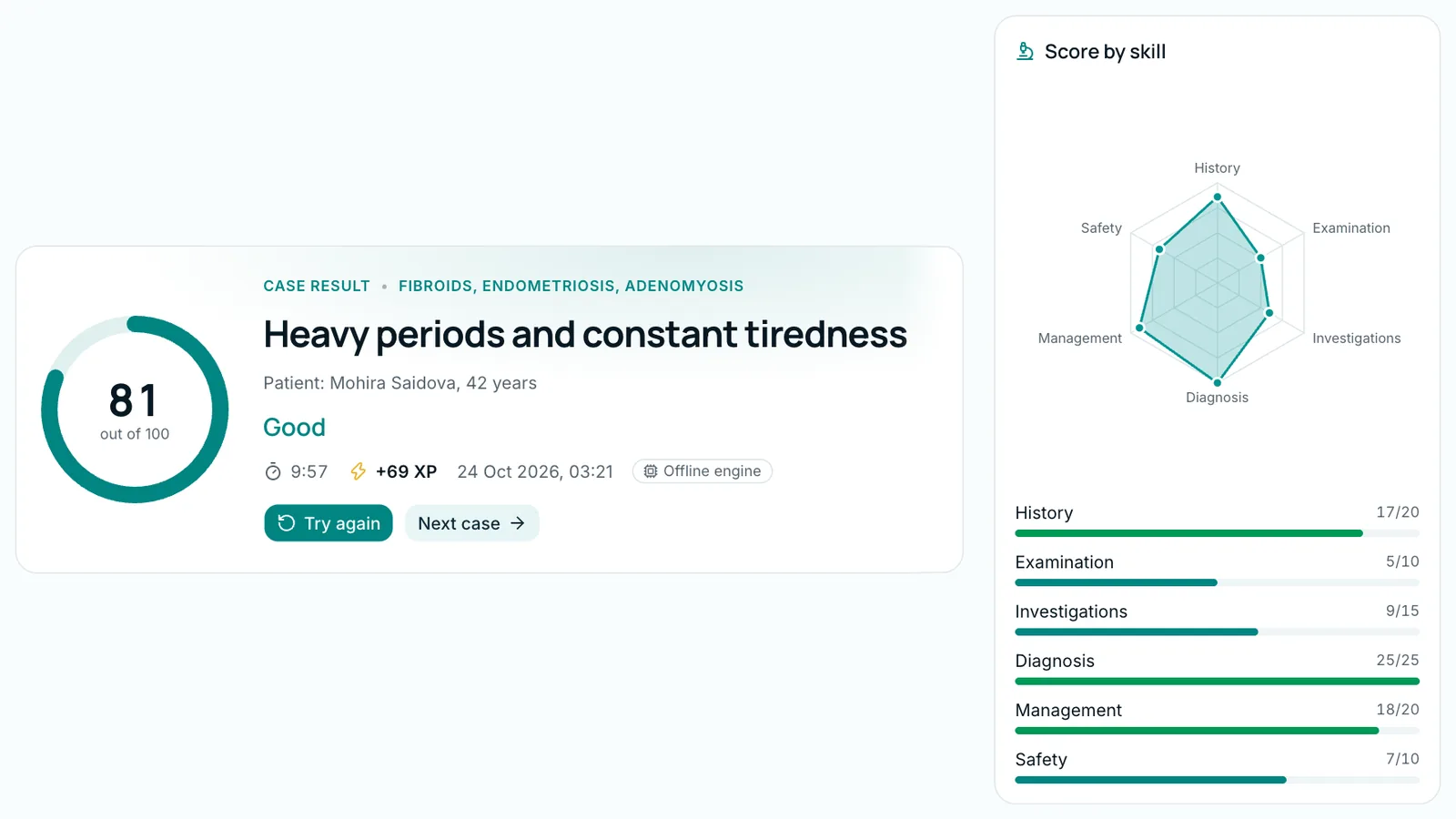
The Virtual patient module on MedIQ has 40 gynaecology cases, 10 in aesthetic gynaecology, 15 in internal medicine and 15 in paediatrics. Every case is built on clinical guidelines (Uzbek Ministry of Health, WHO, NICE, ACOG and others) and lists its sources on the result page. The internal-medicine and paediatrics cases carry a Beta label: checked by MedIQ AI, not yet by a physician. Each brief lists the "Skills assessed" with their weights: History 20%, Examination 10%, Investigations 15%, Diagnosis 25%, Management 20%, Safety 10%.
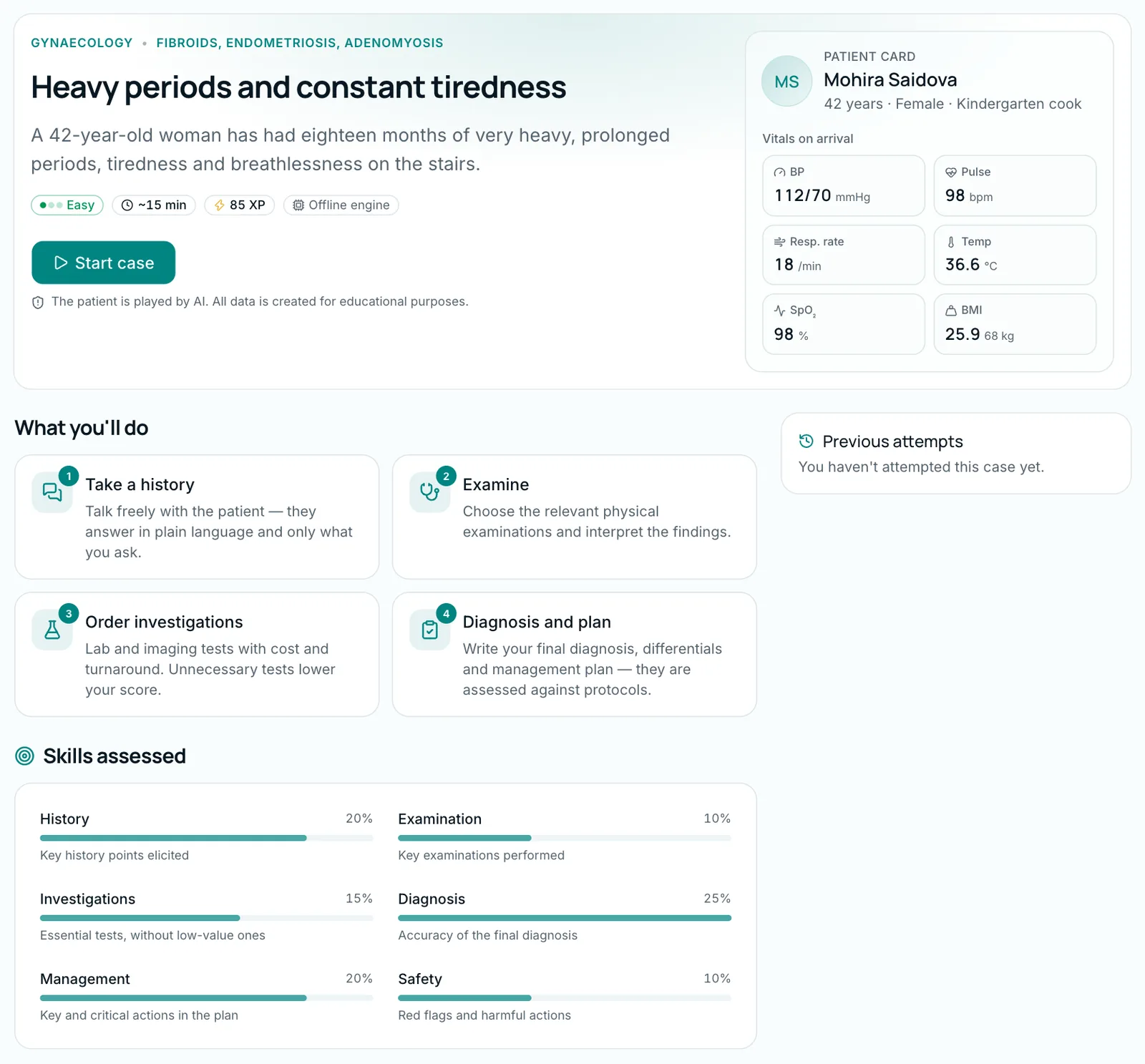
You type your own questions. MedIQ AI plays the patient from a hidden case script. It is instructed to answer only from the case facts, invent nothing and never name the diagnosis; a fact is revealed only when you ask about it. Ask about something the script does not cover, and the patient usually says they don't know, haven't noticed or that it is normal. The "History coverage" panel counts the facts found per section (for example, 2/5) without showing them. Examination and test results do not come from the AI: they come from the case script or, where the script is silent, the normal result in a shared catalogue.
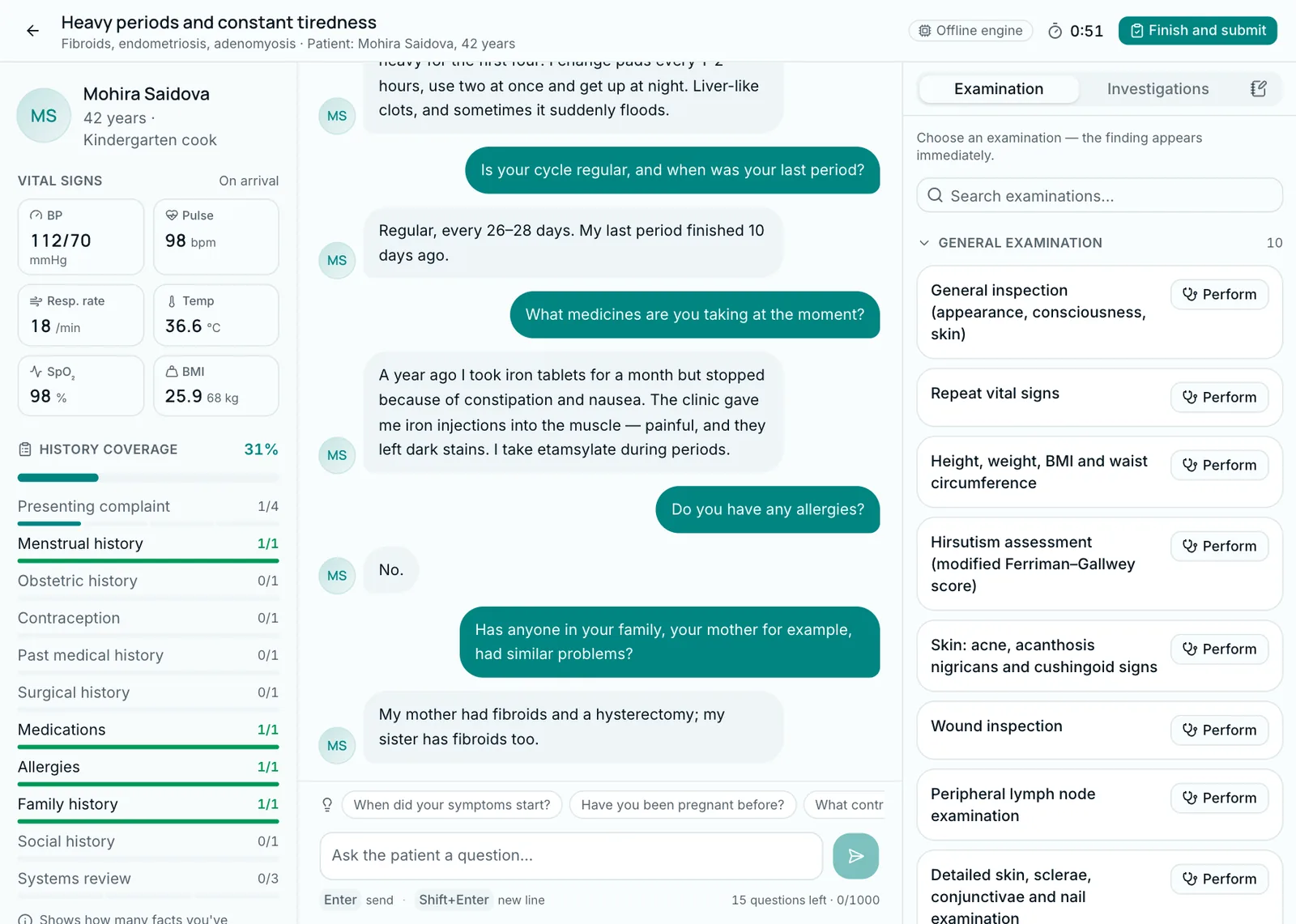
Rules calculate the score; the history part is the share of essential facts you uncovered. Online, the AI patient tags which fact each reply revealed, with keyword matching as a backup; offline, keyword matching does the tagging. At the final assessment, the AI judges only free text (diagnosis, key and harmful actions, red flags) and writes a debrief citing the case's sources; if it fails, a keyword-based offline engine takes over. "Transcript review" shows which fact each answer revealed; "Essential questions not asked" shows what you missed. A vague question can miss a fact, the AI patient can occasionally stray from the script, the offline engine can miss a paraphrase, and the AI can misjudge free text: the debrief is for learning, not a clinical decision.
A 2010 meta-analysis found large effects of virtual patients on knowledge, clinical reasoning and skills against no intervention, but small average differences against non-computer teaching. Comparisons of designs suggested that repetition until mastery, enhanced feedback and explicitly contrasting cases can improve outcomes [8]. So repeat cases, and treat the virtual patient as preparation for real patients, not a replacement. Platform overview: our launch post.
Next time, try three things: start with an open question, ask "anything else?", and follow the medication history down to over-the-counter remedies.
Sources
- 1.Hampton JR, Harrison MJ, Mitchell JR, Prichard JS, Seymour C. Relative contributions of history-taking, physical examination, and laboratory investigation to diagnosis and management of medical outpatients. Br Med J. 1975;2(5969):486–489. doi.org/10.1136/bmj.2.5969.486
- 2.Peterson MC, Holbrook JH, Von Hales D, Smith NL, Staker LV. Contributions of the history, physical examination, and laboratory investigation in making medical diagnoses. West J Med. 1992;156(2):163–165. pmc.ncbi.nlm.nih.gov/articles/PMC1003190/
- 3.Kurtz S, Silverman J, Benson J, Draper J. Marrying content and process in clinical method teaching: enhancing the Calgary-Cambridge guides. Acad Med. 2003;78(8):802–809. doi.org/10.1097/00001888-200308000-00011
- 4.Singh Ospina N, Phillips KA, Rodriguez-Gutierrez R, Castaneda-Guarderas A, Gionfriddo MR, Branda ME, Montori VM. Eliciting the patient's agenda: secondary analysis of recorded clinical encounters. J Gen Intern Med. 2019;34(1):36–40. doi.org/10.1007/s11606-018-4540-5
- 5.Singh H, Giardina TD, Meyer AN, Forjuoh SN, Reis MD, Thomas EJ. Types and origins of diagnostic errors in primary care settings. JAMA Intern Med. 2013;173(6):418–425. doi.org/10.1001/jamainternmed.2013.2777
- 6.Tam VC, Knowles SR, Cornish PL, Fine N, Marchesano R, Etchells EE. Frequency, type and clinical importance of medication history errors at admission to hospital: a systematic review. CMAJ. 2005;173(5):510–515. doi.org/10.1503/cmaj.045311
- 7.National Institute for Health and Care Excellence. Heavy menstrual bleeding: assessment and management (NICE guideline NG88). 2018, last updated July 2026. www.nice.org.uk/guidance/ng88
- 8.Cook DA, Erwin PJ, Triola MM. Computerized virtual patients in health professions education: a systematic review and meta-analysis. Acad Med. 2010;85(10):1589–1602. doi.org/10.1097/ACM.0b013e3181edfe13
This article is written for educational purposes only and is not a basis for clinical decisions. When treating a patient, rely on current clinical guidelines and the judgement of the responsible physician.
Tags
- history taking
- clinical skills
- virtual patient
- Calgary-Cambridge
- doctor-patient communication
- gynaecological history
About the author
MedIQ Editorial
Editorial team for medical education
MedIQ Editorial is the team of clinicians and medical-education specialists who prepare the platform's learning content. Articles are based on current clinical guidelines (WHO, FIGO, ACOG, RCOG, NICE, ESHRE) and peer-reviewed research; sources are listed at the end of every article.